Work07Web application
SiteForge
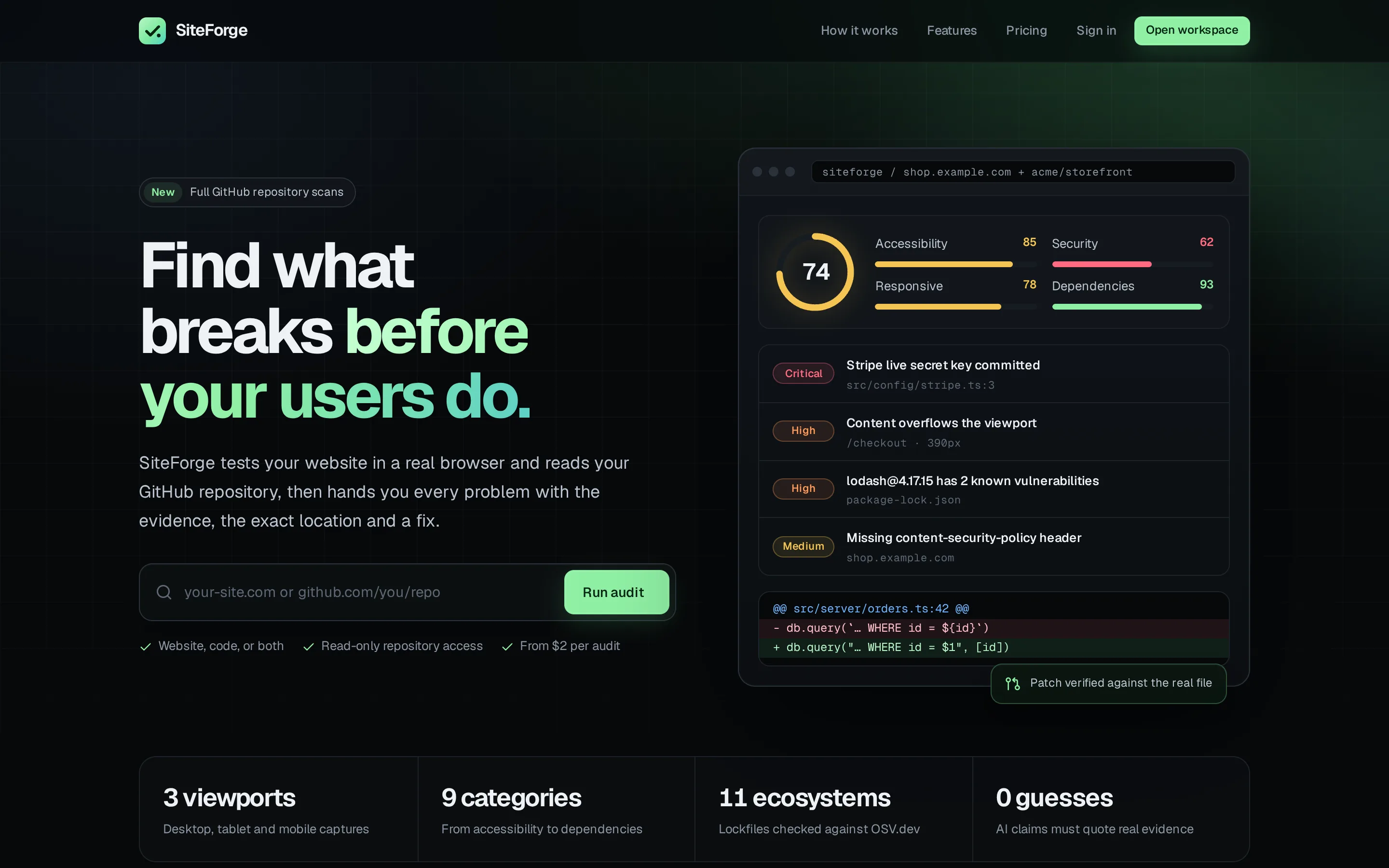
Find what breaks before your users do. Website and code QA. Give it a URL, a GitHub repository or both: it audits the live site in a real browser and scans the repository, then reports every finding with its evidence, its exact location and a suggested fix.
01 /
What it is
SiteForge tests a website in a real browser and reads its GitHub repository, then lists each problem with its evidence, where it is and how to fix it. Next.js serves the workspace while a separate worker performs the audits from a queue, so a long audit never blocks the app.
02 / Details
What it actually does.
- 01
Real browser audits
Pages are loaded in Chromium at three viewports (1440×900, 768×1024 and 390×844) and checked with axe, along with console errors, failed requests, overflow and clipping.
- 02
Repository scans
A pinned commit is checked for leaked secrets, risky code patterns, configuration problems and vulnerable dependencies, using OSV.dev for advisories.
- 03
Evidence, not guesses
An AI finding must quote real code from the file it names or it is discarded, and a suggested patch is kept only if every line it removes exists in that file.
- 04
Queue and worker
The app queues each audit and a separate worker runs it, with per-account limits enforced in the database.
03 / Stack
Built with.
Next.js and React with TypeScript and Tailwind CSS. Supabase provides sign-in, the database and the audit queue; a separate worker drives Chromium through Playwright and runs axe-core on each page.
- 01Next.js
- 02React
- 03TypeScript
- 04Tailwind CSS
- 05Supabase
- 06Playwright
- 07axe-core